Observatoire à Saint-Genis-Laval
Chargement de la carte...
Précision de la localisation : 6 - A priori satisfaisante >> Votre avis :
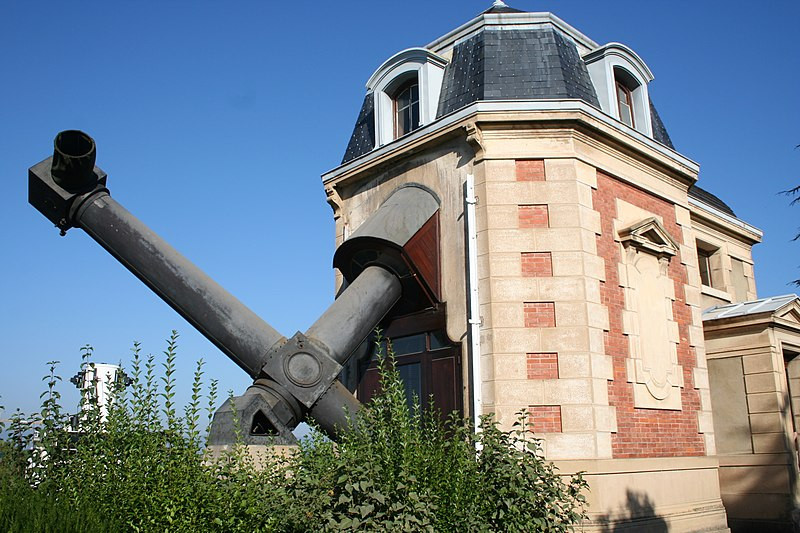
Crédit photo : Denys (fr) - Sous licence Creative Commons
Street View Modifier la localisation
 Monument Historique
Adresse renseignée dans la base Mérimée :
9 avenue Charles-André
69230 Saint-Genis-Laval - France
Code Insee de la commune : 69204
Rhône [69] - Lyon - Rhône Alpes (Auvergne-Rhône-Alpes)
Adresse approximative issue des coordonnées GPS (latitude et longitude) :
9 Avenue Charles André 69230 Saint-Genis-Laval
Eléments protégés :
Les bâtiments de l'observatoire (façades et toitures) , les mires astronomiques, les piliers des instruments, les montures équatoriales Eichens et Brunner, le château d'eau avec son moteur à gaz et sa pompe, le sidérostat et sa lunette fixe, le pavillon Lagrange (bibliothèque) dans sa totalité, le parc et son mur de clôture ainsi que la galerie souterraine (cad. CC 5) : inscription par arrêté du 9 mai 2007 - La lunette équatoriale coudée et le bâtiment qui l'abrite (pavillon avec la salle d'observation et l'abri roulant) (cad. CC 5) : classement par arrêté du 21 avril 2008
Historique :
L'observatoire a été créé en 1878. La construction a été confiée à l'architecte Abraham Hirsch. Il servait à l'origine d'observatoire astronomique et météorologique et devait déterminer l'heure exacte pour les horloges de la ville. Le site est constitué d'un parc comprenant des essences plus que centenaires, et un ensemble de pavillons ayant tous une fonction propre. La lunette équatoriale coudée est le seul des cinq instruments de ce type construits en France à avoir été préservé dans son état d'origine.
Périodes de construction :
4e quart XIXe siècle
Architecte ou maître d'oeuvre :
Hirsch Abraham (architecte)
Propriété de la commune
Informations pratiques de visite ou services :
Ouvert ou fermé à la visite, location de salle, chambres d'hôtes ?
Autres photographies :
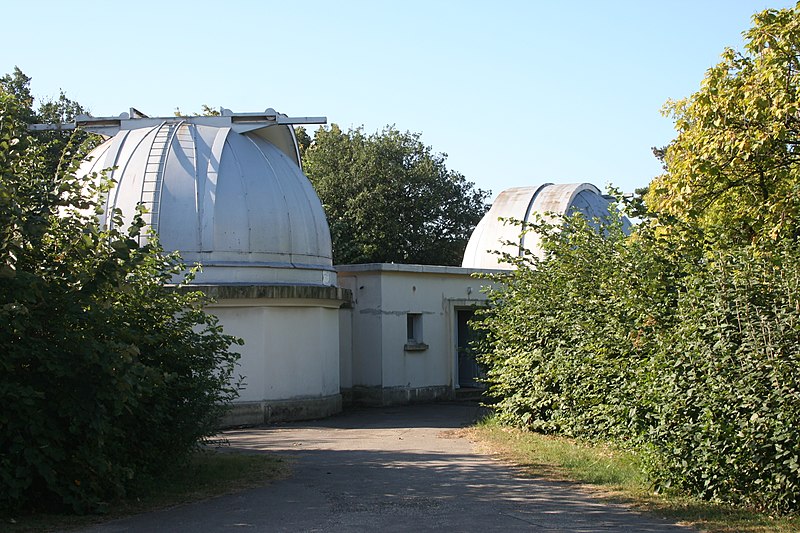
Observatoire à Saint-Genis-Laval
Coupoles des télescopes de 1m et 0,6m de l'observatoire de Lyon
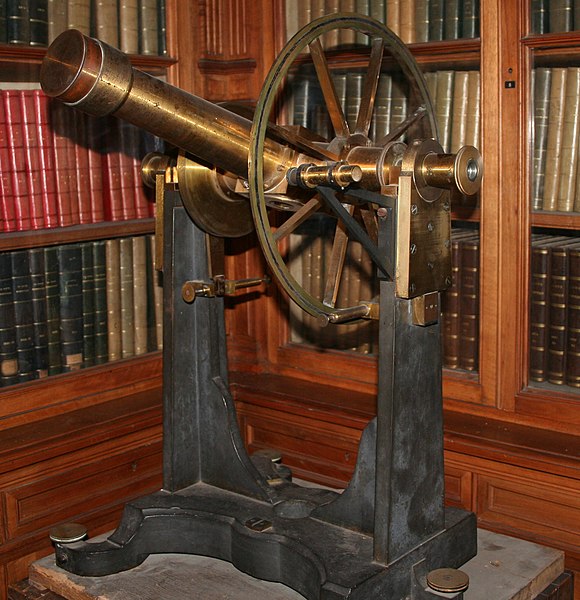
Observatoire à Saint-Genis-Laval
Lunette méridienne de l'observatoire de Lyon

Observatoire à Saint-Genis-Laval
Français : En 1684, le correspondant lyonnais de CASSINI, Jean de Saint-Bonnet, avait fait aménager un observatoire dans le Collège de la Trinité (actuel Lycée Ampère). En 1867, cet observatoire est transféré dans une aile du Palais Saint-Pierre et Charles ANDRE (1842-1912) en est le directeur.
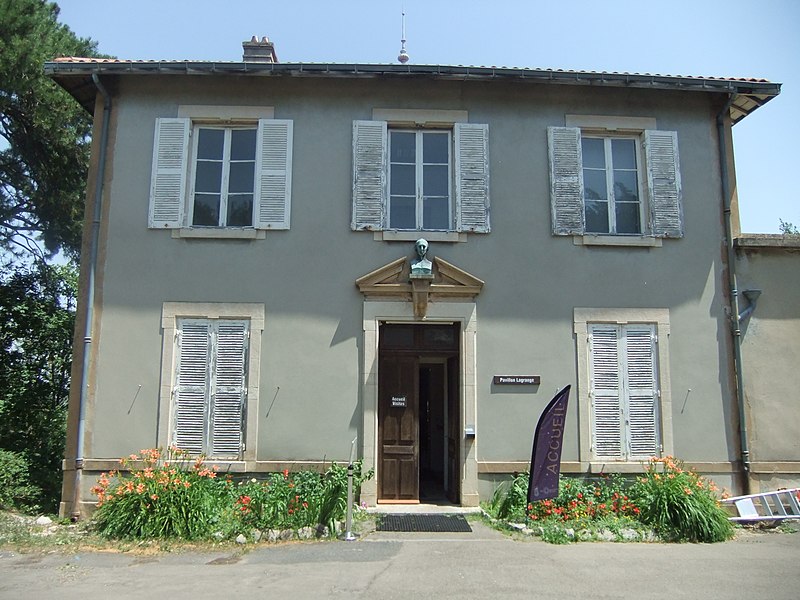
Observatoire à Saint-Genis-Laval
Français : Observatoire de Lyon, localisé à St-Genis-Laval, bâtiment Lagrange en 2022.

Observatoire à Saint-Genis-Laval
Français : Observatoire de Lyon, localisé à St-Genis-Laval, maison du directeur, en 2022.

Observatoire à Saint-Genis-Laval
English: LEDA 1370127 is an irregular spiral galaxy and in the SDSS quasar catalogue. Imaged as part of the Zoogems project.

Observatoire à Saint-Genis-Laval
English: LEDA 1417961 is a Spiral Double Radio-lobe AGN (SDRAGN) from Radio Galaxy Zoo. Imaged as part of the Zoogems project.

Observatoire à Saint-Genis-Laval
English: This intriguing observation from the NASA/ESA Hubble Space Telescope shows a gravitationally lensed galaxy with the long-winded identification SGAS J143845+145407. Gravitational lensing has resulted in a mirror image of the galaxy at the centre of this image, creating a captivating centrepiece. Gravitational lensing occurs when a massive celestial body— such as a galaxy cluster — causes a sufficient curvature of spacetime for the path of light around it to be visibly bent, as if by a lens. Appropriately, the body causing the light to curve is called a gravitational lens, and the distorted background object is referred to as being "lensed". Gravitational lensing can result in multiple images of the original galaxy, as seen in this image, or in the background object appearing as a distorted arc or even a ring. Another important consequence of this lensing distortion is magnification, allowing astronomers to observe objects that would otherwise be too far away or too faint to be seen. Hubble has a special flair for detecting lensed galaxies. The telescope's sensitivity and crystal-clear vision allow it to see faint and distant gravitational lenses that cannot be detected with ground-based telescopes because of the blurring effect ofEarth's atmosphere. Hubble was the first telescope to resolve details within lensed images of galaxies, and is capable of imaging both their shape and internal structure. This particular lensed galaxy is from a set of Hubble observations that take advantage of gravitational lensing to peer inside galaxies in the early Universe. The lensing reveals details of distant galaxies that would otherwise be unobtainable, and this allows astronomers to determine star formation in early galaxies. This in turn gives scientists a better insight into how the overall evolution of galaxies has unfolded. Coordinates Position (RA): 14 38 45.07 Position (Dec): 14° 54' 11.82" Field of view: 1.57 x 1.55 arcminutes Orientation: North is 34.1° left of vertical Colours & filters Band Wavelength Telescope Optical V 606 nm Hubble Space Telescope ACS Optical I 814 nm Hubble Space Telescope ACS Infrared JH 1.4 μm Hubble Space Telescope WFC3

Observatoire à Saint-Genis-Laval
English: The blackness of space is punctuated by bright dots. This image could almost be mistaken for a particularly detailed shot of the night sky as seen from Earth, full of stars. Appearances, however, can be deceptive. This image was taken from Earthʻs southern hemisphere, but the bright dots are not stars — they are galaxies. In fact, the distinctive, ring-shaped galaxy on the right is LEDA 14884. This image was built up using data from the Dark Energy Survey, an ambitious project which mapped hundreds of millions of galaxies across the Universe. This was done using the Dark Energy Camera (DECam), an instrument built by the Department of Energy and mounted at the Víctor M. Blanco 4-meter Telescope at Cerro Tololo Inter-American Observatory (CTIO), a Program of NSF’s NOIRLab. Looking at this incredible image, with its thousands of wildly diverse galaxies, it is mind-boggling to recall that only about 100 years ago, most astronomers believed that our Milky Way was the only galaxy in existence. It was not until 1925 that Edwin Hubble, building upon the work of Henrietta Leavitt and Ejnar Hertzsprung, proved that the Andromeda Galaxy must lie beyond the Milky Way, and humanity began to recognize the sheer scope of the Universe.
![Observatoire - English: DESI (Dark Energy Spectroscopic Instrument) spectrum example showing H-alpha, [N II] and [S II] emission coming from the galaxy LEDA 1787534, showing that it is an emission-line galaxy. H-alpha is truncated for display purposes.
Image Credit: DESI collaboration & Legacy Surveys / D. Lang (Perimeter Institute)
Paper: https://arxiv.org/abs/2306.06308 The spectrum of galaxies and stars can be accessed here: https://www.legacysurvey.org/viewer?ra=4.9119&dec=26.7604&layer=ls-dr9&zoom=15&desi-spec-edr](https://p.monumentum.fr/galerie/maxi/00534/534243-english-desi-dark-energy-spectroscopic-instrument-spectrum-example-showing-h-alpha-n-ii-and-s-ii-emission-coming-from-the-galaxy-leda-1787534-showing-that-it-is-an-emission-line-galaxy-h-alpha-is-trun.jpg)
Observatoire à Saint-Genis-Laval
English: DESI (Dark Energy Spectroscopic Instrument) spectrum example showing H-alpha, [N II] and [S II] emission coming from the galaxy LEDA 1787534, showing that it is an emission-line galaxy. H-alpha is truncated for display purposes. Image Credit: DESI collaboration & Legacy Surveys / D. Lang (Perimeter Institute) Paper: https://arxiv.org/abs/2306.06308 The spectrum of galaxies and stars can be accessed here: https://www.legacysurvey.org/viewer?ra=4.9119&dec=26.7604&layer=ls-dr9&zoom=15&desi-spec-edr

Observatoire à Saint-Genis-Laval
English: Two overlapping spiral galaxies are pictured in this image from the NASA/ESA Hubble Space Telescope. The two galaxies, which have the uninspiring names SDSS J115331 and LEDA 2073461, lie more than a billion light-years from Earth. Despite appearing to collide in this image, the alignment of the two galaxies is likely just by chance— the two are not actually interacting. While these two galaxies might simply be ships that pass in the night, Hubble has captured a dazzling array of interacting galaxies in the past. This image is one of many Hubble observations delving into highlights of the Galaxy Zoo project. Originally established in 2007, the Galaxy Zoo project and its successors are massive citizen science projects which crowdsource galaxy classifications from a pool of hundreds of thousands of volunteers. These volunteers classify galaxies imaged by robotic telescopes and are often the first to ever set eyes on an astronomical object. Over the course of the original Galaxy Zoo project, volunteers discovered a menagerie of weird and wonderful galaxies such as unusual 3-armed spiral galaxies and colliding ring galaxies. The astronomers coordinating the project applied for Hubble time to observe the most unusual inhabitants of the Galaxy Zoo — but true to the project’s crowdsourced roots, the list of targets was chosen by a public vote. Links Video of A Galactic Overlap Coordinates Position (RA): 11 53 31.51 Position (Dec): 36° 0' 22.76" Field of view: 2.91 x 1.64 arcminutes Orientation: North is 33.8° left of vertical Colours & filters Band Wavelength Telescope Optical u 354 nm SDSS Optical G 474 nm Víctor M. Blanco 4-meter Telescope DECam Optical G 477 nm SDSS Optical R 623 nm SDSS Optical R 644 nm Víctor M. Blanco 4-meter Telescope DECam Infrared I 726 nm SDSS Optical Z 913 nm SDSS Optical Z 919 nm Víctor M. Blanco 4-meter Telescope DECam Optical V 606 nm Hubble Space Telescope ACS

Observatoire à Saint-Genis-Laval
English: Face-on spiral galaxy LEDA 744285

Observatoire à Saint-Genis-Laval
English: Face-on spiral galaxy LEDA 744285

Observatoire à Saint-Genis-Laval
Français : Image créée à l'aide du logiciel Aladin Sky Atlas du Centre de Données astronomiques de Strasbourg et des données publiques en format FIT de SDSS (Sloan Digital Sky Survey).

Observatoire à Saint-Genis-Laval
English: This intriguing observation from the NASA/ESA Hubble Space Telescope shows a gravitationally lensed galaxy with the long-winded identification SGAS J143845+145407. Gravitational lensing has resulted in a mirror image of the galaxy at the centre of this image, creating a captivating centrepiece. Gravitational lensing occurs when a massive celestial body — such as a galaxy cluster — causes a sufficient curvature of spacetime for the path of light around it to be visibly bent, as if by a lens. Appropriately, the body causing the light to curve is called a gravitational lens, and the distorted background object is referred to as being "lensed". Gravitational lensing can result in multiple images of the original galaxy, as seen in this image, or in the background object appearing as a distorted arc or even a ring. Another important consequence of this lensing distortion is magnification, allowing astronomers to observe objects that would otherwise be too far away or too faint to be seen. Hubble has a special flair for detecting lensed galaxies. The telescope's sensitivity and crystal-clear vision allow it to see faint and distant gravitational lenses that cannot be detected with ground-based telescopes because of the blurring effect of Earth's atmosphere. Hubble was the first telescope to resolve details within lensed images of galaxies, and is capable of imaging both their shape and internal structure. This particular lensed galaxy is from a set of Hubble observations that take advantage of gravitational lensing to peer inside galaxies in the early Universe. The lensing reveals details of distant galaxies that would otherwise be unobtainable, and this allows astronomers to determine star formation in early galaxies. This in turn gives scientists a better insight into how the overall evolution of galaxies has unfolded.


Observatoire à Saint-Genis-Laval

Observatoire à Saint-Genis-Laval

Observatoire à Saint-Genis-Laval

Observatoire à Saint-Genis-Laval

Observatoire à Saint-Genis-Laval

Observatoire à Saint-Genis-Laval
Fiche Mérimée : PA69000033
Mobilier classé Monument Historique conservé dans l'édifice :
Instrument astrométrique : équatorial coudé
Orgue de tribune
Calice
Ciboire
Petit méridien portatif de Rigaud dans son coffret
Lunette équatoriale d'Eichens-Gautier
Cinq régulateurs astronomiques
Chronomètre de marine et son coffret
Lunette astronomique de Biette
Lunette Bardou
Lunette Normand
Lunette d'amateur et son coffret
Théodolite excentrique et son coffret
Cercle azimutal
Sextant et son coffret
Spectroscope direct
Statoscope enregistreur
Pluviomètre enregistreur
Thermomètre enregistreur
Thermographe Fournier
Hygromètre enregistreur
Miroir noir de Claude Lorrain et son coffret
Baromètre et thermomètre
Horizon artificiel
Galvanomètre
Galvanomètre
Pont de Wheatstone
Boussole d'inclinaison et son coffret
Théodolite magnétique
Pompe à eau
Horloge et sa clé
Buste : Charles Briot
Buste : Louis-Joseph Lagrange
Globe terrestre
Globe céleste
Globe terrestre
Globe céleste
Machine à répartir
Instrument d'observation avec régulateur
Instrument d'observation
Machine à écrire type Japy 3 Y
Machine à calculer
Comparateur de niveau dans son coffret
Onze plaques d'impression
Oculaire micrométrique
Récepteur télégraphique
Système d'entraînement
Chapelle de messe : calice, patène, burettes et leur plateau
Ostensoir
Groupe sculpté : Vierge de Pitié
Dernière mise à jour de la fiche Monumentum : 2026-06-07
Consultez le programme des Journées du Patrimoine pour le Monument Historique Observatoire situé à Saint-Genis-Laval en consultant le programme officiel des JEP 2026.
A proximité :
Saint-Genis-Laval - Château de Beauregard
Saint-Genis-Laval - Château de Lumagne
Saint-Genis-Laval - Château de la Tour
Pierre-Bénite - Domaine du château le Petit-Perron
Oullins - Ecole Saint-Thomas-d'Aquin (ancien château)
Oullins - Immeuble Le Castel
Brignais - Maison de La Jamayère
Brignais - Maison de Mijolla
Pierre-Bénite - Manoir du Grand-Perron , dans l'enceinte de l'hôpital Jules-Courmont
Saint-Genis-Laval - Villa Chapuis
Cartes postales anciennes à proximité :


