Gisement de Laugerie-Basse aux Eyzies
Chargement de la carte...
Précision de la localisation : 6 - A priori satisfaisante >> Votre avis :

Crédit photo : Pymouss - Sous licence Creative Commons
Street View Modifier la localisation
 Monument Historique
Adresse renseignée dans la base Mérimée :
24620 Les Eyzies-de-Tayac-Sireuil - France
Code Insee de la commune : 24172
Dordogne [24] - Périgueux - Aquitaine (Nouvelle-Aquitaine)
Adresse approximative issue des coordonnées GPS (latitude et longitude) :
1 Laugerie Basse 24620 Les Eyzies-de-Tayac-Sireuil
Eléments protégés :
Le gisement (cad. A 835 à 837, 838p, 839) : classement par arrêté du 25 avril 1940
Historique :
Site archéologique acquis par le département le 22 juin 2011.
Périodes de construction :
Préhistoire, Paléolithique supérieur
Propriété du département
Informations pratiques de visite ou services :
Ouvert ou fermé à la visite, location de salle, chambres d'hôtes ?
Autres photographies :

Gisement de Laugerie-Basse aux Eyzies
Français : Dans la falaise, le gisement préhistorique (époque magdalénienne, 15.000BP, en bas) et le "trou du guetteur" médiéval, (en haut), abri de Laugerie-Basse, Les Eyzies-de-Tayac, Dordogne.

Gisement de Laugerie-Basse aux Eyzies
Français : Laugerie-Basse, en 2011

Gisement de Laugerie-Basse aux Eyzies
Français : Laugerie-Basse, en 2011

Gisement de Laugerie-Basse aux Eyzies
Français : Abri de Laugerie-Basse, Les Eyzies-de-Tayac-Sireuil en Dordogne

Gisement de Laugerie-Basse aux Eyzies
Français : Laugerie-Basse, en 2011

Gisement de Laugerie-Basse aux Eyzies
English: Auroch found in Laugerie Basse rockshelter, Les Eyzies-de-Tayac, Dordogne, France. It can be viewed in the National Prehistory Museum in Les Eyzies-de-Tayac.

Gisement de Laugerie-Basse aux Eyzies
Deutsch: Fundplatz Laugerie-Basse bei Les Eyzies-de-Tayac-Sireuil in Frankreich.

Gisement de Laugerie-Basse aux Eyzies

Gisement de Laugerie-Basse aux Eyzies
Deutsch: Fundplatz Laugerie-Basse bei Les Eyzies-de-Tayac-Sireuil in Frankreich. Horizonte 10-16. An den mit Ziffern markierten Stellen wurden Knochen entnommen für vergleichende Untersuchungen mit einer Fundstelle in Südwest-Tasmanien.

Gisement de Laugerie-Basse aux Eyzies
Deutsch: Der Fundplatz Laugerie-Basse bei Les Eyzies-de-Tayac-Sireuil in Frankreich. Am oberen Bildrand Horizont 10, unten Horizont 16. An den mit Ziffern markierten Stellen wurden Knochen entnommen für vergleichende Untersuchungen mit einer Fundstelle in Südwest-Tasmanien.

Gisement de Laugerie-Basse aux Eyzies
Français : Abri préhistorique de Laugerie-Basse aux Eyzies-de-Tayac-Sireuil : vue depuis la grotte du Grand Roc.

Gisement de Laugerie-Basse aux Eyzies
Français : Abri préhistorique de Laugerie-Basse aux Eyzies-de-Tayac-Sireuil : reconstitution d'habitat.

Gisement de Laugerie-Basse aux Eyzies
Français : Abri préhistorique de Laugerie-Basse aux Eyzies-de-Tayac-Sireuil.

Gisement de Laugerie-Basse aux Eyzies
Français : Abri préhistorique de Laugerie-Basse aux Eyzies-de-Tayac-Sireuil : stratigraphie du site.

Gisement de Laugerie-Basse aux Eyzies
Français : Abri préhistorique de Laugerie-Basse aux Eyzies-de-Tayac-Sireuil.

Gisement de Laugerie-Basse aux Eyzies
Français : Abri préhistorique de Laugerie-Basse aux Eyzies-de-Tayac-Sireuil : le trou du guetteur.

Gisement de Laugerie-Basse aux Eyzies
Français : Abri préhistorique de Laugerie-Basse aux Eyzies-de-Tayac-Sireuil : vestige d'arche médiévale.

Gisement de Laugerie-Basse aux Eyzies
Français : Abri préhistorique de Laugerie-Basse aux Eyzies-de-Tayac-Sireuil : le site vu de la RD 47.

Gisement de Laugerie-Basse aux Eyzies
Français : Musée d'Archéologie Nationale - Salle Piette - Plaquette de la femme au renne - bois de renne gravé du Magdalénien moyen. MAN47001

Gisement de Laugerie-Basse aux Eyzies
Français : Maurice Bourlon à Laugerie-Basse en 1911

Gisement de Laugerie-Basse aux Eyzies
English: FIG. l. Handle of a Dagger sculptured in Ivory into the form of a Reindeer (⅔). Rock-shelter of Bruniquel. FIG. 2. Mammoth sculptured in Reindeer-horn (⅔). Rock-shelter of Bruniquel. FIG. 3. Unknown Animal sculptured in Reindeer-horn (1/1). Laugerie Basse. Animals sculptured in Ivory and Horn. [To face p. 209.

Gisement de Laugerie-Basse aux Eyzies
View of Laugerie-Basse, Tyac (Dordogne). Wellcome Images Keywords: topography; prehistory; Archaeology; Geography

Gisement de Laugerie-Basse aux Eyzies
Français : Instruments de musique préhistoriques : Flûte en os (Isturitz, Pyrénées-Atlantiques) Sifflet en os (Laugerie-Basse, Dordogne) Rhombe en bois de renne (Lalinde, Dordogne) Racleur en bois de renne (Mas d'Azil, Ariège) Collections du Musée d'Archéologie Nationale

Gisement de Laugerie-Basse aux Eyzies
English: Title: The American Museum journal Identifier: americanmuseumjo15amer (find matches) Year: c1900-(1918) (c190s) Authors: American Museum of Natural History Subjects: Natural history Publisher: New York : American Museum of Natural History Contributing Library: American Museum of Natural History Library Digitizing Sponsor: Biodiversity Heritage Library View Book Page: Book Viewer About This Book: Catalog Entry View All Images: All Images From Book Click here to view book online to see this illustration in context in a browseable online version of this book. Text Appearing Before Image: 238 THE AMERICAN MUSEUM JOURNAL some sheltering cliff, all traces of the spot and its relics would be lost. Hence, we may properly take for granted that hundreds of archpeological stations will remain undisco^'ered, in consequence of which our notion of the actual strength of the population at any given place during these early millenniums of human existence must continue imperfect, if not inadequate. As need hardly be stated the presence of natural habitations depends ordinarily on a high relief or a more or less moun- tainous topography. Caves are most abundant in volcanic regions as in the western United States or in limestone areas such as Kentucky and adjacent commonwealths. Shelters are notable features of steep-walled valleys or box- canons and our own cliff-dweller region affords the best example of them and their utilization. In P^urope the most famous cave groups are located in the lower French Pyrenees and their Canta- brian extension in northern Spain, while the equally famous shelter region in- cludes short sections of the \ ezere and Beune Valleys at Les Eyzies, in the French department of Dordogne. Both regions are wonderfully picturesque and impressive and barring some alterations in the flora they have not changed much in general appearance since the arrival of palaeolithic man. These caves and shelters are all in limestone formations and are the results chiefly of mechanical erosion. Some of the caves, especially those of the lower altitudes, are still in process of making, while others, well up on the mountain sides, are very ancient — in fact, were in their old age when man first entered them. Roughly speaking, the shelters proper, that is the overhanging cliffs and the wide open grottos, were the homes of paliieolithic man and therefore naturally furnish us with important data concern- ing his physical make-up, his practical Text Appearing After Image: The Vezere River, its floodplain and cliff wall as seen from the entrance to the Gorge d'Enfer, above Les Eyzies, France. The station of La Micoque is on the extreme right, Laugerie Haute at the foot of the distant cliff and Laugerie Basse nearer by off the first bend in the stream Note About Images Please note that these images are extracted from scanned page images that may have been digitally enhanced for readability - coloration and appearance of these illustrations may not perfectly resemble the original work.

Gisement de Laugerie-Basse aux Eyzies
Français : Laugerie-Basse, Dordogne. Poisson gravé sur mandibule de renne.

Gisement de Laugerie-Basse aux Eyzies
"This double plate comprises figures of some of the choicest specimens of prehistoric art, and some of the most valuable (as indicative of primaeval taste and habits) that the caves of Aquitaine have yielded. Carvings of horse and and reindeer, and sketchings of ibex, and sketchings of ibex and two bovine forms. From the rock shelter of Laugerie-Basse". Dans Édouard Lartet & Henry Christy (éd. par Thomas Rupert Jones), Reliquiae aquitanicae : being contributions to the archaeology and palaeontology of Périgord and the adjoining provinces of Southern France, 1875, planche B - XIX. Voir la description des planches ici. Cette demi-planche est en complément de la planche 20.

Gisement de Laugerie-Basse aux Eyzies
"This double plate comprises figures of some of the choicest specimens of prehistoric art, and some of the most valuable (as indicative of primaeval taste and habits) that the caves of Aquitaine have yielded. Carvings of horse and and reindeer, and sketchings of ibex, and sketchings of ibex and two bovine forms. From the rock shelter of Laugerie-Basse". Dans Édouard Lartet & Henry Christy (éd. par Thomas Rupert Jones), Reliquiae aquitanicae : being contributions to the archaeology and palaeontology of Périgord and the adjoining provinces of Southern France, 1875, planche B - XX. Voir la description des planches ici. Cette demi-planche est en complément de la planche 19.

Gisement de Laugerie-Basse aux Eyzies
Woodcut illustration in W. Boyd Dawkins (1880), Early man in Britain and his place in the tertiary period, p. 213. The legend says: " Fig. 77. The Hunting of the Urus, Duruthy Cave, 1/2. " But in p. 212-213, text related to this image says: " (...) incised on a piece of antler, left behind by one if the hunters in his dwelling at Laugerie-Basse (Fig. 77) and figured by M. Massenat, shows that the game was sometime stalked. A large ox is represented feeding, with his head down, while behind a naked human figure, with dishevelled hair and beard, has crept up, and is in the act of throwing a spear. The victim is considered by M. Massenat to be a bison, but the double curvature, as well as the length of the horns, prove that it was the urus (...) " Thus there is an error in the legend and this piece comes from Laugerie-Basse.

Gisement de Laugerie-Basse aux Eyzies
Laugerie Basse. Grottboplats från Magdalénienepoken.

Gisement de Laugerie-Basse aux Eyzies
Laugerie Basse. Grottboplats från Magdalénienepoken.

Gisement de Laugerie-Basse aux Eyzies
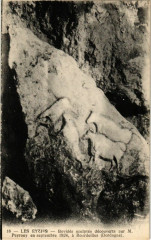
Français : Carte postale de Laugerie-Basse (Les Eyzies, Dordogne, France)

Gisement de Laugerie-Basse aux Eyzies
Français : Carte postale de Laugerie-Basse (Les Eyzies, Dordogne, France)

Gisement de Laugerie-Basse aux Eyzies
Français : Carte postale de Laugerie-Basse (Les Eyzies, Dordogne, France)

Gisement de Laugerie-Basse aux Eyzies
Français : Carte postale de Laugerie-Basse (Les Eyzies, Dordogne, France)

Gisement de Laugerie-Basse aux Eyzies
Français : Carte postale de Laugerie-Basse (Les Eyzies, Dordogne, France)

Gisement de Laugerie-Basse aux Eyzies
Français : Carte postale de Laugerie-Basse (Les Eyzies, Dordogne, France)

Gisement de Laugerie-Basse aux Eyzies
Français : Bâton en bois de renne percé, orné de motifs circulaires, évoquant peut-être une cordelette. Abri de Laugerie-Basse, Les Eyzies, Dordogne. Musée de l'Homme.

Gisement de Laugerie-Basse aux Eyzies
Français : Lissoir en os décoré de motifs géométriques. Abri classique de Laugerie-Basse, Les Eyzies, Dordogne. Magdalénien moyen/supérieur, v. 19000-14000 AP. Musée de l'Homme

Gisement de Laugerie-Basse aux Eyzies
Français : Lissoir en os (hémicôte) gravé figurant des bovinés. Abri de Laugerie-Basse, Les Eyzies, Dordogne, v. 19000-14000 AP. Musée de l'Homme.

Gisement de Laugerie-Basse aux Eyzies
Français : Lissoir en os, figurant une queue de poisson et une tête d'équidé gravée. Abri de Laugerie-Basse, Les Eyzies, v. 19000-14000 AP. Musée de l'Homme.

Gisement de Laugerie-Basse aux Eyzies
Français : Hémi-mandibule de renne avec un poisson gravé (brochet, saumon ou esturgeon). Abri de Laugerie-Basse, Les Eyzies, Dordogne, v. 17000-14000 AP cal. Musée de l'Homme.

Gisement de Laugerie-Basse aux Eyzies
Français : Plaquette en schiste gravée sur deux faces. Ici la première face, représentant cinq rennes, dont un mâle dans la moitié droite (ramure visible au centre), flairant une femelle. Le surnom de la plaquette évoque un "combat", mais c'est plutôt une représentation d'accouplement. Abri de Laugerie-Basse, Les Eyzies, Dordogne. Magdalénien moyen/supérieur, v. 17000-14000 AP. Musée de l'Homme.

Gisement de Laugerie-Basse aux Eyzies

Gisement de Laugerie-Basse aux Eyzies

Gisement de Laugerie-Basse aux Eyzies

Gisement de Laugerie-Basse aux Eyzies

Gisement de Laugerie-Basse aux Eyzies

Gisement de Laugerie-Basse aux Eyzies

Gisement de Laugerie-Basse aux Eyzies
Fiche Mérimée : PA00082540
Dernière mise à jour de la fiche Monumentum : 2026-10-08
Consultez le programme des Journées du Patrimoine pour le Monument Historique Gisement de Laugerie-Basse situé aux Eyzies en consultant le programme officiel des JEP 2026.
A proximité :
Les Eyzies - Abri de Cro-Magnon
Les Eyzies - Abri à sculpture dit Abri du Poisson et abri Lartet
Les Eyzies - Gisement de la Micoque
Les Eyzies - Gisement préhistorique de Laugerie-Haute
Les Eyzies - Gisement préhistorique du Pataud
Les Eyzies - Grotte d'Abzac
Les Eyzies - Grotte de la Croze
Les Eyzies - Grotte et gisement de l'Oreille d'Enfer
Les Eyzies - Manoir de Roucaudou
Les Eyzies - Église Saint-Martin de Tayac
Cartes postales anciennes à proximité :