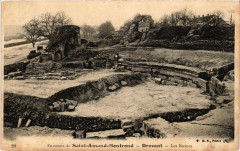
Vestiges gallo-romains à Drevant
Chargement de la carte...
Précision de la localisation : 6 - A priori satisfaisante >> Votre avis :

Crédit photo : KoS - Sous licence Creative Commons
Street View Modifier la localisation
 Monument Historique
Adresse renseignée dans la base Mérimée :
18200 Drevant - France
Code Insee de la commune : 18086
Cher [18] - Bourges - Centre (Centre-Val de Loire)
Adresse approximative issue des coordonnées GPS (latitude et longitude) :
6 Chemin des Ruines 18200 Drevant
Eléments protégés :
Les ruines romaines (cad. 55, 56, 59, 62, 67, 82, 274, 275, 335 ; 1984 ZI 33 à 35 ; non cadastré ; domaine public communal) : classement par liste de 1840 - La parcelle 67 (cad. AN 67) : classement par arrêté du 6 août 1992
Historique :
Le sanctuaire a été fouillé en 1834 par Hazé, conservateur des monuments historiques. Dès 1834, il y notait les restes d'un temple [...], de deux établissements de bains et d'un vaste théâtre.
Vestiges gallo-romains datant du IIe siècle ; destruction presque totale au VIe siècle ; installation sur les lieux d'un atelier de potier à partir du VIIe siècle ; puis au cours du moyen âge, construction de plusieurs maisons ; édification d'une chapelle au XVIe siècle ; seules subsistent les ruines du théâtre antique qui commencèrent à être dégagées et étudiées en 1834 sous la direction d'Haze
Périodes de construction :
Ier siècle, IIe siècle
Propriété de l'État
Informations pratiques de visite ou services :
Ouvert ou fermé à la visite, location de salle, chambres d'hôtes ?
Photographies de la base Mémoire (de 1851 à 1914) :

Vestiges gallo-romains à Drevant
Ruines

Vestiges gallo-romains à Drevant
Ruines
Autres photographies :

Vestiges gallo-romains à Drevant
Français : Ruines du Forum gallo-romain de Drevant, Cher, France.

Vestiges gallo-romains à Drevant
Français : Les principaux vestiges de Drevant sur un plan de voirie moderne.

Vestiges gallo-romains à Drevant
Français : Enceinte sacrée (faussement appelée puits) dans le sanctuaire

Vestiges gallo-romains à Drevant
Français : Ruines gallo-romaines de Drevant, Cher, France.

Vestiges gallo-romains à Drevant
Français : Ruines du Forum gallo-romain de Drevant, Cher, France.

Vestiges gallo-romains à Drevant
Français : Ruines de l'entrée du Forum gallo-romain de Drevant, Cher, France.

Vestiges gallo-romains à Drevant
Cher Drevant Theatre Romain 08042010

Vestiges gallo-romains à Drevant
Français : L'amphithéâtre gallo-romain de Drevant, Cher, France.

Vestiges gallo-romains à Drevant
Français : Partie de l'amphithéâtre gallo-romain de Drevant, Cher, France.

Vestiges gallo-romains à Drevant
Français : L'amphithéâtre gallo-romain de Drevant, Cher, France.

Vestiges gallo-romains à Drevant
Le théâtre gallo-romain de Drevant. Le théâtre en forme de demi-cercle a un diamètre de 85 m et pouvait accueillir plus de 4000 spectateurs. 4 rangées de gradins subsistent sur les 24 existants à l'origine. L’arène de 27 m de diamètre est bordée d'un mur de plus de 2m de hauteur constitué de cinq assises de gros blocs de grès. La construction date probablement du 1er ou IIème siècle apr. J.-C. Le théâtre a été remanié plusieurs fois pour en augmenter la capacité d'accueil. The Gallo-Roman theater of Drevant. Theater in a semi-circle has a diameter of 85 m and could seat 5,000 to 8,000 spectators. 4 rows of bleachers remain on the existing 24 originally. The arena is 27 m in diameter surrounded by a wall 2.80 m high consisting of five bases of large sandstone blocks. The Construction probably dates from the first or second century after Christ. The theater was remodeled several times to increase the capacity.

Vestiges gallo-romains à Drevant
Le théâtre gallo-romain de Drevant. Le théâtre en forme de demi-cercle a un diamètre de 85 m et pouvait accueillir plus de 4000 spectateurs. 4 rangées de gradins subsistent sur les 24 existants à l'origine. L’arène de 27 m de diamètre est bordée d'un mur de plus de 2m de hauteur constitué de cinq assises de gros blocs de grès. La construction date probablement du 1er ou IIème siècle apr. J.-C. Le théâtre a été remanié plusieurs fois pour en augmenter la capacité d'accueil. The Gallo-Roman theater of Drevant. Theater in a semi-circle has a diameter of 85 m and could seat 5,000 to 8,000 spectators. 4 rows of bleachers remain on the existing 24 originally. The arena is 27 m in diameter surrounded by a wall 2.80 m high consisting of five bases of large sandstone blocks. The Construction probably dates from the first or second century after Christ. The theater was remodeled several times to increase the capacity.

Vestiges gallo-romains à Drevant
Drevant (Cher)

Vestiges gallo-romains à Drevant
Le théâtre gallo-romain de Drevant. Le monument est presque entièrement visible, sauf la partie nord-est des gradins, qui est couverte par un habitat moderne. The Gallo-Roman theater of Drevant. The monument is almost entirely visible, except the north-east bleachers, which is covered by a modern habitat.

Vestiges gallo-romains à Drevant
Le théâtre gallo-romain de Drevant. Le théâtre en forme de demi-cercle a un diamètre de 85 m et pouvait accueillir plus de 4000 spectateurs. Ici la partie nord-est supérieure de l’arène. The Gallo-Roman theater of Drevant. Theater in a semi-circle has a diameter of 85 m and can accommodate more than 4,000 spectators. By the north-eastern part of the upper arena.

Vestiges gallo-romains à Drevant
Le théâtre gallo-romain de Drevant. Le théâtre en forme de demi-cercle a un diamètre de 85 m et pouvait accueillir plus de 4000 spectateurs. Ici la partie nord-est supérieure de l’arène. The Gallo-Roman theater of Drevant. Theater in a semi-circle has a diameter of 85 m and can accommodate more than 4,000 spectators. By the north-eastern part of the upper arena.

Vestiges gallo-romains à Drevant
Ensemble gallo-romain de Drevant (Cher). The GalloRoman sanctuary of Drevant (Cher). Le théâtre. L’arche du vomitorium, passage permettant la sortie de l’amphithéâtre. The arch of vomitorium, allowing the output of the amphitheater.

Vestiges gallo-romains à Drevant
Le théâtre gallo-romain de Drevant. Le théâtre en forme de demi-cercle pouvait accueillir plus de 4000 spectateurs. La cavea*, orientée sud-ouest, était vraisemblablement divisée en trois parties, ima, media et summa cavea. Partiellement adossée à une pente et partiellement soutenue par des substructions voûtées, elle a un diamètre de 85 mètres et la forme d'un arc outrepassé. Des contreforts obliques (ici) soutiennent les extrémités de la cavea, qui se révèle donc coupée dans ses gradins supérieurs. La cavea est la partie du théâtre où se trouvent les gradins.La cavea peut-être creusée à flanc de colline ou supportée par des arcades. The Gallo-Roman theater of Drevant. Theater in the form of semicircle could accommodate more than 4,000 spectators. The cavea*, facing south-west, was probably divided into three parts, ima, media and summa cavea. Partially backed by a slope and partially supported by vaulted substructures, it has a diameter of 85 meters and the shape of a horseshoe arch. Oblique buttresses (here) support the ends of the cavea, which thus appears cut in its upper level seating. The cavea is part of the theater where the bleachers. The cavea can be dug into the hillside or supported by arches.

Vestiges gallo-romains à Drevant
Le théâtre gallo-romain de Drevant. Le monument est presque entièrement visible, sauf la partie nord-est des gradins, qui est couverte par un habitat moderne. The Gallo-Roman theater of Drevant. The monument is almost entirely visible, except the north-east bleachers, which is covered by a modern habitat.

Vestiges gallo-romains à Drevant
Ensemble gallo-romain de Drevant (Cher). The GalloRoman sanctuary of Drevant (Cher). Le théâtre. L’arche du vomitorium, passage permettant la sortie de l’amphithéâtre. The arch of vomitorium, allowing the output of the amphitheater.

Vestiges gallo-romains à Drevant
Le théâtre gallo-romain de Drevant. Le théâtre en forme de demi-cercle a un diamètre de 85 m et pouvait accueillir plus de 4000 spectateurs. 4 rangées de gradins subsistent sur les 24 existants à l'origine. L’arène de 27 m de diamètre est bordée d'un mur de plus de 2m de hauteur constitué de cinq assises de gros blocs de grès. La construction date probablement du 1er ou IIème siècle apr. J.-C. Le théâtre a été remanié plusieurs fois pour en augmenter la capacité d'accueil. The Gallo-Roman theater of Drevant. Theater in a semi-circle has a diameter of 85 m and could seat 5,000 to 8,000 spectators. 4 rows of bleachers remain on the existing 24 originally. The arena is 27 m in diameter surrounded by a wall 2.80 m high consisting of five bases of large sandstone blocks. The Construction probably dates from the first or second century after Christ. The theater was remodeled several times to increase the capacity.

Vestiges gallo-romains à Drevant
Ensemble gallo-romain de Drevant (Cher). The GalloRoman sanctuary of Drevant (Cher). Le théâtre. L’arche du vomitorium, passage permettant la sortie de l’amphithéâtre. The arch of vomitorium, allowing the output of the amphitheater.

Vestiges gallo-romains à Drevant
Ensemble gallo-romain de Drevant (Cher). The GalloRoman sanctuary of Drevant (Cher). Le sanctuaire improprement appelé « forum ». Le sanctuaire est constitué d'une grande esplanade de 116 m de longueur et 89 m de largeur. Vestiges du seuil de l’entrée monumentale de la façade est. Ce seuil est constitué d’un sol bétonné enserré de blocs de grès de grand appareil posés sur des petits murets. The sanctuary improperly called "forum". The sanctuary consists of a large esplanade of 116 meters long and 89 m wide. Remains threshold monumental entrance facade. This threshold consists of a concrete floor contained sandstone blocks large device placed on small walls.

Vestiges gallo-romains à Drevant
Le théâtre gallo-romain de Drevant. Le théâtre en forme de demi-cercle a un diamètre de 85 m et pouvait accueillir plus de 4000 spectateurs. 4 rangées de gradins subsistent sur les 24 existants à l'origine. L’arène de 27 m de diamètre est bordée d'un mur de plus de 2m de hauteur constitué de cinq assises de gros blocs de grès. La construction date probablement du 1er ou IIème siècle apr. J.-C. Le théâtre a été remanié plusieurs fois pour en augmenter la capacité d'accueil. The Gallo-Roman theater of Drevant. Theater in a semi-circle has a diameter of 85 m and could seat 5,000 to 8,000 spectators. 4 rows of bleachers remain on the existing 24 originally. The arena is 27 m in diameter surrounded by a wall 2.80 m high consisting of five bases of large sandstone blocks. The Construction probably dates from the first or second century after Christ. The theater was remodeled several times to increase the capacity.

Vestiges gallo-romains à Drevant
Le théâtre gallo-romain de Drevant. Le théâtre en forme de demi-cercle a un diamètre de 85 m et pouvait accueillir plus de 4000 spectateurs. 4 rangées de gradins subsistent sur les 24 existants à l'origine. L’arène de 27 m de diamètre est bordée d'un mur de plus de 2m de hauteur constitué de cinq assises de gros blocs de grès. La construction date probablement du 1er ou IIème siècle apr. J.-C. Le théâtre a été remanié plusieurs fois pour en augmenter la capacité d'accueil. L'orchestra/arène, telle qu'elle apparaît aujourd'hui, a une forme circulaire (D : 27 m). Elle est entourée par un mur de podium (ht : 2,60 m), dessinant un arc de cercle de 254°. Ce mur est percé par trois ouvertures menant à trois pièces identifiées comme des pièces de services ou des sacella. The Gallo-Roman theater of Drevant. Theater in a semi-circle has a diameter of 85 m and could seat 5,000 to 8,000 spectators. 4 rows of bleachers remain on the existing 24 originally. The arena is 27 m in diameter surrounded by a wall 2.80 m high consisting of five bases of large sandstone blocks. The Construction probably dates from the first or second century after Christ. The theater was remodeled several times to increase the capacity. The orchestra / arena, as it appears today, has a circular shape (D: 27 m). It is surrounded by a wall of podium (ht: 2,60 m), drawing an arc of 254 °. This wall is pierced by three openings leading to three parts identified as serving pieces, or sacella.

Vestiges gallo-romains à Drevant
Ensemble gallo-romain de Drevant (Cher). The GalloRoman sanctuary of Drevant (Cher). Le sanctuaire improprement appelé « forum ». Le sanctuaire est constitué d'une grande esplanade de 116 m de longueur et 89 m de largeur. Ce grand rectangle était entourée d'une galerie de boutiques. Ici, le pavillon de l’angle sud-est du sanctuaire. The sanctuary improperly called "forum". The sanctuary consists of a large esplanade of 116 meters long and 89 m wide. This large rectangle was surrounded by a gallery of shops. Here, the construction of the southeast corner of the sanctuary.

Vestiges gallo-romains à Drevant
Ensemble gallo-romain de Drevant (Cher). The GalloRoman sanctuary of Drevant (Cher). Le sanctuaire improprement appelé « forum ». Le sanctuaire est constitué d'une grande esplanade de 116 m de longueur et 89 m de largeur. Dans cette esplanade centrale se trouvait un fanum (temple) carré. L’emplacement du fanum est indiqué par les arbustes. The sanctuary improperly called "forum". The sanctuary consists of a large esplanade of 116 meters long and 89 m wide. In this central esplanade was a fanum (temple) square. The location indicated by the fanum shrubs.

Vestiges gallo-romains à Drevant
Ensemble gallo-romain de Drevant (Cher). The GalloRoman sanctuary of Drevant (Cher). Le sanctuaire improprement appelé « forum ». Le sanctuaire est constitué d'une grande esplanade de 116 m de longueur et 89 m de largeur. Ici le pavillon sud-ouest avec son étrange édicule octogonal. The sanctuary improperly called "forum". The sanctuary consists of a large plaza 116 meters long and 89 m wide. Here the southwest pavilion with its strange octagonal aedicule.

Vestiges gallo-romains à Drevant
Ensemble gallo-romain de Drevant (Cher). The GalloRoman sanctuary of Drevant (Cher). Le sanctuaire improprement appelé « forum ». Le sanctuaire est constitué d'une grande esplanade de 116 m de longueur et 89 m de largeur. Ce grand rectangle était entourée d'une galerie de boutiques. Ici, le pavillon de l’angle sud-est du sanctuaire. The sanctuary improperly called "forum". The sanctuary consists of a large esplanade of 116 meters long and 89 m wide. This large rectangle was surrounded by a gallery of shops. Here, the construction of the southeast corner of the sanctuary.

Vestiges gallo-romains à Drevant
Ensemble gallo-romain de Drevant (Cher). The GalloRoman sanctuary of Drevant (Cher). Le sanctuaire improprement appelé « forum ». A l’angle sud ouest du sanctuaire, un petit édicule octogonal dont la fonction ne peut être précisée. La cavité circulaire de cet édicule était remplie de débris de terres cuites. Aucune trace d’eau n’ayant été trouvée, il ne s’agirait donc pas d’un puits. Quand un endroit était frappé par la foudre, il était considéré comme sacré et on l’entourait d’un puteal (de puteus: puits) pour l’empêcher d’être foulé par des pieds. C’est peut-être le cas ici. The sanctuary improperly called "forum". At the southwest corner of the sanctuary, a small octagonal aedicule whose function can not be specified. The circular cavity of this aedicule was filled with debris terracotta. No trace of water having been found, it would therefore not a well. When a place was struck by lightning, it was considered sacred and was surrounded by a Puteal (from puteus: well) to prevent it from being trampled by the feet. This may be the case here. Le Puteal Scribonianum (Scribonian Puteal) ou Puteal Libonis (Puteal de Libo) est une structure dans le Forum Romanum à Rome antique. Un Puteal était une tête de puits classique, rond ou carré, parfois, placé au sommet d'une ouverture de puits pour empêcher les gens de tomber dedans The Puteal Scribonianum (Scribonian Puteal) or Puteal Libonis (Puteal of Libo) was a structure in the Forum Romanum in Ancient Rome. A puteal was a classical wellhead, round or sometimes square, placed atop a well opening to keep people from falling in.

Vestiges gallo-romains à Drevant
Drevant (Cher, Saint-Amand-Montrond) - Ruins of a Temple. View this map on the BL Georeferencer service. Image taken from: Title: "Notices pittoresques sur les antiquités et les monumens du Berri" Shelfmark: "British Library HMNTS 10170.f.8." Page: 67 Place of Publishing: Bourges Date of Publishing: 1834 Issuance: monographic Identifier: 001628248 Explore: Find this item in the British Library catalogue, 'Explore'.Download the PDF for this book (volume: 0) Image found on book scan 67 (NB not necessarily a page number) Download the OCR-derived text for this volume: (plain text) or (json) Click here to see all the illustrations in this book and click here to browse other illustrations published in books in the same year. Order a higher quality version from here.

Vestiges gallo-romains à Drevant

Vestiges gallo-romains à Drevant

Vestiges gallo-romains à Drevant
French architectural photographer

Vestiges gallo-romains à Drevant
French architectural photographer

Vestiges gallo-romains à Drevant

Vestiges gallo-romains à Drevant

Vestiges gallo-romains à Drevant

Vestiges gallo-romains à Drevant
Fiche Mérimée : PA00096786
Dernière mise à jour de la fiche Monumentum : 2026-10-10
Consultez le programme des Journées du Patrimoine pour le Monument Historique Vestiges gallo-romains situé à Drevant en consultant le programme officiel des JEP 2026.
A proximité :
Drevant - Ancienne chapelle
Saint-Amand-Montrond - Ancienne église des Carmes
Saint-Georges-de-Poisieux - Château de Poisieux
Colombiers - Château de la Salle
Colombiers - Croix de cimetière
 Ainay-le-Vieil - Musée Saint-Vic
Ainay-le-Vieil - Ouvrages du canal de Berry
Colombiers - Ouvrages du canal de Berry
La Groutte - Rempart préhistorique de l'éperon barré
Saint-Amand-Montrond - Église Saint-Amand
Ainay-le-Vieil - Musée Saint-Vic
Ainay-le-Vieil - Ouvrages du canal de Berry
Colombiers - Ouvrages du canal de Berry
La Groutte - Rempart préhistorique de l'éperon barré
Saint-Amand-Montrond - Église Saint-Amand
Cartes postales anciennes à proximité :