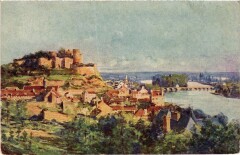
Maison dite des Etats généraux, actuellement Musée des Amis du Vieux Chinon à Chinon
Chargement de la carte...
Précision de la localisation : 6 - A priori satisfaisante >> Votre avis :

Crédit photo : BENJAMIN SMITH - Sous licence Creative Commons
Street View Modifier la localisation
 Monument Historique
Adresse renseignée dans la base Mérimée :
44 rue Voltaire
37500 Chinon - France
Code Insee de la commune : 37072
Indre et Loire [37] - Tours - Centre (Centre-Val de Loire)
Adresse approximative issue des coordonnées GPS (latitude et longitude) :
44 Rue Haute Saint-Maurice 37500 Chinon
Eléments protégés :
La maison (cad. AR 86) : inscription par arrêté du 12 novembre 1926
Historique :
L'immeuble présente une façade entièrement en pierre, avec tourelle en encorbellement à l'un des angles. De nombreuses modifications ont été apportées dans sa disposition. Au rez-de-chaussée, les ouvertures ont été remaniées pour l'aménagement de boutiques. Au premier étage, la baie centrale agrandie a reçu un balcon en fer. Seule la tourelle semble ne pas avoir été modifiée.
Edifice contenant des vestiges du XIIe ou XIIIe siècle ; bâtiments 1ère moitié XVe siècle ; décor du pignon sur rue aux étages début XVIe siècle ; remaniements XVIIIe siècle ; restauration en 1970 avec quelques interprétations, l'aile ouest n'existe plus depuis 1850 environ, Richard Coeur de Lion y serait mort en 1199, Charles VII y aurait réuni les états généraux en 1427 et 1428, peintures murales XIVe et XVe siècle, hôtellerie à l'enseigne du Lion vert à partir de 1521, puis de la Boule d'or au début du XIXe siècle ; actuellement musée des amis du vieux Chinon
Périodes de construction :
XIVe siècle, XVe siècle
Propriété privée
 Musée de France associé : Le Carroi, musée d'arts et d'histoire
Informations pratiques de visite ou services :
Ouvert ou fermé à la visite, location de salle, chambres d'hôtes ?
Autres photographies :

Maison dite des Etats généraux, actuellement Musée des Amis du Vieux Chinon à Chinon
Les châteaux de la Loire.
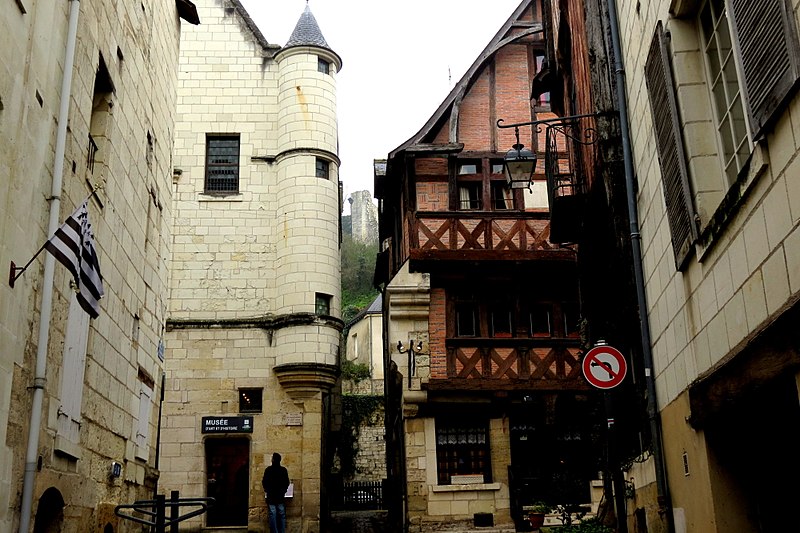
Maison dite des Etats généraux, actuellement Musée des Amis du Vieux Chinon à Chinon
Les châteaux de la Loire.

Maison dite des Etats généraux, actuellement Musée des Amis du Vieux Chinon à Chinon
Les châteaux de la Loire.
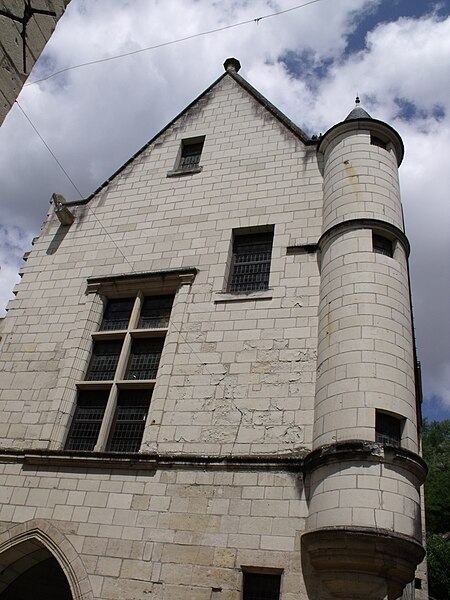
Maison dite des Etats généraux, actuellement Musée des Amis du Vieux Chinon à Chinon
Chinon is a commune located in the Indre-et-Loire department in the Region Centre, France. The regional area is called the Touraine, which is known as the "garden of France". It is well known for its wine, castle, and historic town. Chinon played an important and strategic role during the Middle Ages, having served both French and English kings. Chinon is in the Loire valley, registered as a UNESCO World Heritage Site since 2000. The historic town of Chinon is on the banks of the Vienne River about 10 kilometres (6 mi) from where it joins the Loire. Settlement in Chinon dates from prehistoric times, with a pronounced importance for both French and English history in the Middle Ages. At this period rivers were the main trade routes, and the Vienne River joins both the fertile regions of the Poitou and the city of Limoges, and is a tributary of the Loire, which acted as a traffic thoroughfare. The site was fortified early on, and by the 5th century a Gallo-Roman castrum had been established there. Towards the mid 5th century, a disciple of St Martin, St Mexme, established first a hermitage, and then a monastery to the east of the town. This religious foundation bearing his name flourished in the medieval period, being rebuilt and extended four times. The eventual complex contained a large and highly decorated church and a square of canons' residences. Closure and partial demolition during and after the Revolution of 1789 have damaged this once very important church. The imposing second façade still stands, with its nave dating from the year 1000 A.D. Its important remains have been restored as historical monument and a cultural centre. During the Middle Ages, Chinon further developed, especially under Henry II (Henry Plantagenêt, Count of Anjou, and crowned King of England in 1154). The castle was rebuilt and extended, becoming his administrative center and a favourite residence. It was where court was frequently held during the Angevin Empire. On Henry's death at the castle in 1189, Chinon first passed to his eldest surviving son from his marriage with Eleanor of Aquitaine, Richard I the Lionheart. On Richard's death in 1199, it then passed to the youngest of their children, John Lackland. King John would lose the castle in a siege in 1205 to the French king Philip II Augustus, from which date it was included in the French royal estates as the royal duchy of Touraine. The castle in Chinon served as a prison for a time when Philip IV the Fair ordered the Knights Templar arrested in 1307. Jacques de Molay, Grand Master, and a few other dignitaries of the Order of the Temple were incarcerated there prior to trial and eventual execution. Chinon again played a significant role in the struggle for the throne between the French and the English during the Hundred Years' War (1337-1453) when the heir apparent, the future Charles VII of France sought refuge and installed his court in there in 1425. The province remained faithful to him and he made lengthy stays with his court there. In 1429, the 17-year-old Joan of Arc came to Chinon to meet and to acknowledge him as the rightful heir to the throne. After interrogation to prove she had been sent on a mission from God and with the men and arms then accorded to her, she would go on to break the siege of Orleans in June and open the way for Charles to be crowned at Reims in July 1429. The meetings in Chinon with the future Charles VII of France and his acceptance of her was the turning point of the war, helping to establish both firmer national boundaries and sentiment. Chinon also served Louis XII as he waited for the papal legate Caesar Borgia to bring the annulment papers from Jeanne de France, enabling him to marry Anne of Brittany in 1498, and thus solidifying an even more coherent French territory At the end of the 15th century, the commune of Chinon was the birthplace of the writer, humanist, philosopher and satirist François Rabelais, author of Gargantua and Pantagruel amongst other works, which figure in the canon of great world literature. The region is the scene of these fantastic, critical and observant adventures. From the sixteenth century, Chinon was no longer a royal residence, and in 1631 it became part of the estates of the Duke of Richelieu, who neglected the fortress. Apart from townhouses and convents that were built, the city changed little up to the Revolution. In the 1820s, however, the fortifications were pulled down and the banks of the Vienne River were opened up to the outside. In the late 19th and 20th centuries, Chinon grew to the east, towards the railway station, and to the north on the hill. The historic centre was registered as a conservation area in 1968, and since that time has been undergoing restoration in order to preserve its historic, natural and architectural identity. Rue Haute Saint-Maurice Musee Le Carrol Now a museum of local history, it was once the scene of France's first attempt at a Parliament, which met in the upper room to fund the war against the English in 1428.

Maison dite des Etats généraux, actuellement Musée des Amis du Vieux Chinon à Chinon

Maison dite des Etats généraux, actuellement Musée des Amis du Vieux Chinon à Chinon

Maison dite des Etats généraux, actuellement Musée des Amis du Vieux Chinon à Chinon

Maison dite des Etats généraux, actuellement Musée des Amis du Vieux Chinon à Chinon

Maison dite des Etats généraux, actuellement Musée des Amis du Vieux Chinon à Chinon
Fiche Mérimée : PA00097680
Dernière mise à jour de la fiche Monumentum : 2026-09-16
Consultez le programme des Journées du Patrimoine pour le Monument Historique Maison dite des Etats généraux, actuellement Musée des Amis du Vieux Chinon situé à Chinon en consultant le programme officiel des JEP 2026.
A proximité :
Chinon - Ancien hôtel des Monnaies
Chinon - Ancien palais du Bailliage
Chinon - Hôtel
Chinon - Hôtel des Gouverneurs, ou du Gouvernement
Chinon - Hôtel dit Commanderie de l'Hôpital
 Anché - Le Carroi, musée d'arts et d'histoire
Chinon - Maison du 15e siècle
Chinon - Maison du 15e siècle, dite aux Dragons engoulants
Chinon - Maison rouge
Chinon - Maison à pans de bois
Anché - Le Carroi, musée d'arts et d'histoire
Chinon - Maison du 15e siècle
Chinon - Maison du 15e siècle, dite aux Dragons engoulants
Chinon - Maison rouge
Chinon - Maison à pans de bois
Cartes postales anciennes à proximité :